Thursday, June 2, 2022


F. M. MODESTO – SODA WATER


An early view of I Street in Modesto, California, with its notoriously poor street conditions. The root of the name coming from the Spanish word for ‘modesty’, it has certainly been all that. Developed as a new railroad town, in the late 1860’s, it shifted the commercial focus for the area from the waning mining activities to agriculture. It is probably best known as the headquarters for the E & J Gallo Winery, the largest family owned winery in the United States. Another claim to fame is the childhood home of movie mogul, George Lucas, who co-created and directed the movie, “American Graffiti” (1973), which was loosely based on Lucas’ teenage years growing up in Modesto during the 1960’s


Frederick Meinecke was born in Hanover, Germany, about 1823. Like so many young men of the time he became drawn by the word of great riches in the far off land that had recently been wrested from Mexico and was known as California. Arriving in San Francisco in October 1849, he made his way to the ‘gold fields’, likely speaking no English and thrust into a melting pot of humanity from all points of the world. It is quite possible that he befriended another German, either on his arduous 150 day sea voyage from Hamburg or shortly thereafter. In 1851 Ernst Lodtmann formed a partnership with Meinecke in a venture to bring a herd of cattle from the ‘States’ to California. Over-wintering in the Salt Lake area the partners returned to California in 1852. They established a dairy ranch on the Calaveras River about four miles from Stockton. Although the partnership split up in 1857 it appears the two retained a good relationship and probably had continued business ventures for a number of years thereafter. However, at about this time Meinecke left California and returned to his homeland of Hanover, Germany. It is probable he had a specific purpose in mind for he returned to California about late 1860 or 1861 along with his new bride, Sophia, also a native of Germany.


Meinecke continued his farming activities but moved to the north bank of the Stanislaus River further south. Here he established a ferry across the river which attracted others who located there. A small settlement soon arose which was known by the name of Meinecke. A few years later Frederick Meinecke formed a partnership with Charles E. Taylor and the ferry business became known as Meinecke & Taylor’s Ferry. They also opened a grocery store at the same location. In 1867 Taylor was appointed postmaster for the little settlement of Meinecke.


One of the very few items found that document the settlement of Meinecke, which was named after Frederick Meinecke. (Stockton Independent, January 4, 1867)

 Meinecke was also involved in moving merchandise up and down the Tuolumne and San Joaquin Rivers in 1868 when he and three others incorporated the Tuolumne City Steamboat Company, with capital stock at $70,000. ( Daily Evening Herald, Stockton, California, December 4,1868)  The success of this company has not been determined.

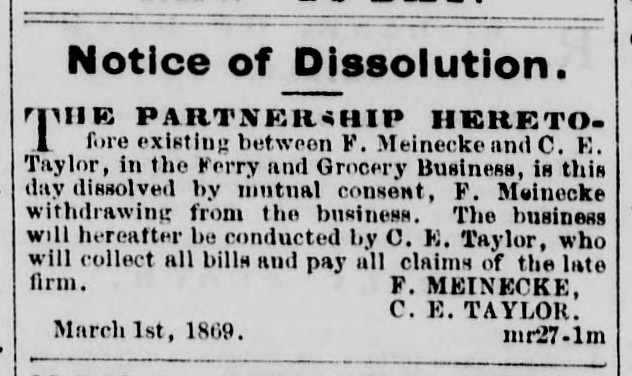
 In 1869 Meinecke gave up his partnership with Taylor and moved on to other ventures, which primarily included the operation of his 800 acre ranch property.


This advertisement documents the dissolution of the partnership between Meinicke and Taylor in 1869. (Stockton Independent, March 27, 1869). The ferry crossing soon became known as simply “Taylor’s Ferry”. The small settlement of Meinecke soon disappeared as well.


This portion of an 1881 map by Wallace W. Elliott & Co. locates the geographical position of Taylor’s crossing (see red dot) which was the previous location of Meinecke’s Ferry.


 As noted above, Meinecke and Lodtmann maintained an amicable business relationship over the years, which is highlighted by the Lodtmann brothers later soda water activities. Earnest (Ernst) and Justus Lodtmann had initially established their soda water factory at Knights Ferry about 1867, along with their Miners’ Brewery. With that towns decline and with Modesto emerging as a town of great promise the Lodtmann brothers moved their soda water factory to Modesto by August 1868, but kept their brewery at Knight’s Ferry.

 The planning stage of the proposed rail line through the central valley of California essentially changed the human geography of the area. Along with the proposed new town of Modesto came a wholesale movement of towns and their people to this new hub of the rail line. The nearby towns of Empire, Tuolumne and Paradise essentially moved, including their buildings, to Modesto. It even usurped the county seat of government, Knight’s Ferry, by 1871. By 1874 the Lodtmann brothers sold their brewery at Knights Ferry and sold their Modesto soda factory to Frederick Meinecke the same year.


The newspaper notice documenting the beginning of Frederick Meinecke's soda water business in Modesto, California. Stanislaus County Weekly News (Modesto, California May 22,1874, Page 2)


 It has not been determined when Meinecke gave up his soda factory in Modesto, however; the 1879 and 1880 voting register for Stanislaus County lists Meinecke as only a farmer. Even during the period he operated the soda factory Meinecke continued with his farming activities, which consisted primarily of grain crops. It must be assumed that the soda factory was a short lived venture that fit somewhere between the years of 1874 and 1879. In fact, after his initial opening, there were no more newspaper articles found that mentioned his soda works.


The Meinecke soda bottles were undoubtedly blown in San Francisco. They are marked F M / MODESTO, on one side. No other variants are known.


Frederick and Sophia Meinecke had four children – all born in San Joaquin County:

 Edward Meinecke, born about 1861, Died 15 Nov 1939, in Modesto

Katie Meinecke, born about 1863, Died 7 May 1949, in Modesto

Meta Meinecke, born about 1865, Died 20 Oct 1949, in Modesto

Sophia Meinecke, born about 1871, Died 2 April 1940, in Modesto


Frederick Meinecke died near Modesto on 19 February 1907. Meinecke’s wife, Sophia, died February 12, 1925 in Modesto. It is somewhat strange that their four children, noted above, never married and had no issue. And, for the most part, the siblings lived together until their deaths.

Friday, April 29, 2022

 More on S.D. BALDWIN'S LINIMENT

As an addendum to the previous write-up on Baldwin’s Liniment, it is true that additional batches of the bottle were blown at a later date. Neatly made tooled top versions were produced and, thanks to my good friend, Frank Sternad, he sent me an advertisement from the 1878 Marysville Directory for the product. Oddly, it contains the same text as the ad published ten years earlier. I am not sure what to make of that but it is now well documented that Baldwin was still selling the liniment at that point in time and probably a few years later.


This is a good lesson in how difficult it can be to research 19th century items and retrieve all the important information. The best we can do is try, and eventually, we will assemble a reasonable history of many of our collectible bottles.


The later tooled top variant of S.D. Baldwin's Liniment


Friday, April 22, 2022

 S. D. BALDWIN'S LINIMENT

Stephen Dexter Baldwin was born about 1806 in Windsor, Berkshire, Massachusetts, the youngest of six children. Shortly after his birth, Stephen and his family moved to Riga, Monroe County, New York, where his father was a farmer, and most of his family lived out their lives.

Stephen married Lois Chamberlin about 1833 and they settled in Brockport, Sweden Township, Monroe County, New York, just north of Riga. He was a farmer and fathered four children, all born between 1834 and 1848. 

Stephen is likely the same “S.D. Baldwin” who was scheduled in the 1850 U.S. census for Tuolumne County, California – listed as a miner. Little is known of his life during this early gold rush period. It appears his mining venture had some success for Baldwin went back home and arrived in San Francisco, along with his family, in 1855 on the SS Cortes. (Daily Alta California, 21 January 1855) Exactly when he opened his jewelry store in Marysville, California, is not known, but newspaper accounts show him in the business as early as 1858.

Baldwin suffered some setbacks in the beginning. His house burned in Marysville on 3 November 1859 and by 1861 he was forced into bankruptcy. (Daily National Democrat ,Marysville, Calif., 26 Apr 1861) With hard work and determination he eventually succeeded in his business, but was always looking for additional economic possibilities. He even landed a contract with the city of Marysville to maintain and wind the city clock.


By 1863 Baldwin had moved to larger quarters and began advertising. Signs of his success became obvious. (Marysville Daily Appeal, 10 June 1863)

The ‘sideline’ business that has caught the attention of bottle collectors is the manufacture of his liniment. Its earliest record is noted when he received a copyright for “S.D.Baldwin’s Neuralgia Liniment”, registered with the Northern District Court of California, on 17 December 1866. He would have had his bottles blown for his liniment at about the same time.


The bottles are about 6.25 inches in height with separately applied tops. One side is embossed S.D. BALDWIN’S / LINIMENT, in two lines. The glass has the unmistakable character of the product of one of the two functioning glass works located in San Francisco. This example has some unusual strings of glass adhered to its surface, accidentally made during the blowing process.


The opposite side is embossed, MARYSVILLE / CAL, which leaves no room for a bottle label. It is currently not possible to determine exactly when the bottles were blown, or how many batches were made. It is likely that they were first blown in late 1866 or early 1867, and judging from the relatively short marketing period, there were few if any further batches.


The only newspaper advertisement of any significance is this one, which ran from February to August 1868.

No other advertisements for Baldwin’s liniment have been located, which is an indication that it didn’t do very well in the market. Only one other reference was noted that he wholesaled some of his product to R.H. McDonald & Co. in San Francisco. (Daily Alta California, 5 August 1867)  If profits from the sales of a product don’t cover the cost of advertising it is not unusual for the proprietor to no longer support it. It is likely that Baldwin ultimately only sold his liniment through his jewelry store which would limit sales considerably. Just one, rather novel mention of the liniment was noted after 1868, which is an indication of his remaining inventory, and shown in the news article below.


This whimsical article is the last mention of Baldwin’s Liniment that was located. If there is any truth in it the strength of the concoction must have been powerful. (Marysville Daily Appeal, 29 February 1872)

 Baldwin seems to have continued his quest for profitable ventures beyond his jewelry store, and he felt assured that he discovered his ticket to wealth in the tules that were abundant in the marshy lands around his home town. News articles laid praise to his new discovery. “ Mr. B. has for some considerable time had experiments going on here and in the East, and has finally succeeded in establishing the fact that the native tule, which grows so abundant, in almost endless tracts of cheap swamp lands in California, can be economically manufactured into first-class papers. (Pacific Rural Press, 2 March 1872)

For reasons that seemingly defy logic, he even went so far as obtaining a U.S patent for the use of tules in the making of paper.


Baldwin’s new invention simply consisted of the use of the common tule found throughout much of California as a medium for making paper.

 His patent apparently died an unceremonious death as no further documentation was located regarding paper making with tules in California, Actually, other tule species had been used in making paper for centuries in other parts of the world. It was almost as if he was duped into this belief by others who saw a chance to obtain some of Baldwin’s funds during his research and development process.

 Baldwin continued with his Marysville jewelry store until about 1880 when he retired from the business which was then run for a few years by his son-in-law, Perry Corey.

 Baldwin’s obituary notes, … “He was well known in this section of the State, and was greatly esteemed and respected for his high character and his genial social qualities”. He was found slumped over in his ‘easy chair’, spectacles on his nose, and newspaper at his feet, on January 27, 1882. (Marysville Daily Appeal, 28 January 1882)  He is buried in the Baldwin crypt in the Marysville city cemetery.


Friday, March 18, 2022

Tuesday, December 14, 2021


PACIFIC CONGRESS WATER 

An interesting little tidbit came to light awhile back when I was doing some research. Sometimes when I get a lot of “hits” when doing newspaper research, I often don’t bother looking at those that appear to be way out of the time period for a particular item. This happened when searching for “Pacific Congress Springs”. The hotel was destroyed by fire in 1903 and the associated bottling activity had already stopped by then. One hit showed up that was dated 1911 and I didn’t bother to check it for a long time, but my curiosity got the best of me.

It was totally not what I had expected but was so interesting that I thought I would share it, as it really relates to the very beginnings of the Pacific Congress bottles in an unusual way. The organizers of the springs were the financier, Darius Ogden Mills and the lucky miner, turned financier, Alvinza Hayward, in 1864.  The Pacific Congress Springs Company was organized in San Francisco in November 1865, with a capital stock of $100,000, divided into two hundred shares.  

As many people know, the State of California initiated a trade mark system as early as 1861 which allowed proprietors certain legal protection to help deter imitators from stealing their profits. This was the case with the Pacific Congress Springs when they decided to bottle and sell their water. Begun as early as 1864, the springs soon became quite popular and fearing the probability of unscrupulous competitors, by 1868 the company decided to trade mark its name, as well as specifically protecting their bottles.


This handwritten document is a portion of the trade mark registration for Pacific Congress water, registered with the State of California as Trade Mark No. 113, on October 21, 1868. It clearly notes that an example of the bottle to be trademarked was submitted along with the necessary paperwork. This was an unusual precedent since most trademarks were submitted by picture or drawing since an actual object could present obvious storage or filing issues for a governmental agency. Nevertheless, an actual bottle was submitted to the care of the California Secretary of State, which is even further documented by way of the Sacramento Daily Union of October 22, 1868, which noted, . . . “The trade-mark of the Pacific Congress Springs Company, and likewise a bottle of the Congress water for which the trademark is claimed, were filed in the office of the Secretary of State yesterday.” This statement makes it sound as if the bottle was even full of spring water. Perhaps it was.

As time went by trade mark registrations continued into the files of the State – in fact, thousands of files, for any number of different goods. The older documents would eventually be stored in odd ‘out-of-the-way’ places at the Capitol, to make room for more current or more relevant items. Employees would retire, or find other jobs, and files would often become forgotten, fragmented or even lost. This is an all too common issue that most of us can relate to.

Nearly fifty years passed when a new position was created at the state capitol in Sacramento.  The former editor of the Watsonville Pajaronian, George Radcliff, was given the job by the new governor. This position was titled ‘Superintendent of the Capitol and Grounds’ for the capitol building. It was his job to create a smoothly running ‘house’ within which our elected officials could operate. Apparently, one of his duties was to deal with some of the neglected papers, etc. that had accumulated in various storage rooms in the old building. I am sure he stumbled upon any number of items for which he had to make a judgment call on what to do with it. At least he would need to ask someone else their opinion as to what should be done with some of the ‘stuff’. As is often the case, no one really knows what should be done with some of the items, and usually had no interest in it. It would often be relegated to the trash.

This was the case when Radcliff happened upon an old bottle which was apparently part of a trade mark submission. Being an old newspaper man, he saw a story in his find. Whether he wrote most of the copy is not known, but the article played up the age of the bottle found among the rubble.


The meaning of Adam’s Ale has been somewhat lost in time, but it refers to the only drink available to the first man to inhabit the earth in the biblical text – water. (Sacramento Bee, July 20, 1911 Sacramento, CA, Page: 5)


It is not clear if that old bottle of Pacific Congress Water has survived to the present day, but I do wonder if one of the impressive deep blue variants was given to the Secretary of State as the trade mark example.


A rendering of the Pacific Congress Springs in 1876, while under the ownership of Lewis A. Sage.

Monday, November 8, 2021

MAC - a "cure" for Train Sickness and Sea Sickness~


I’d never heard of Smith Bros. of Fresno until I bought a huge collection from that area several years ago. In it, was a bottle that I found intriguing. Embossed on the obverse “M.A.C. / For Dyspepsia / And Constipation / Smith Bros. / Fresno Cal. “and “For Sea Sickness” on one side panel with “Train Sickness” on the other. I’m not a cure collector per se, but this just had too much going for it to sell it.

Oddly enough, I could locate a “Smith Bros.” doing business as a pharmacist / druggist in Fresno around the turn of the century, but could only find one Smith; a George H.. Was the brother a silent partner, or was this an attempt by George to piggyback onto the Smith Brothers of cough drop fame of the same era?...

Smith Bros first started appearing in advertisements dating to 1898. They were puffing their miracle cure for dandruff.  San Jose must have been a hotbed for this disease because they advertised incessantly in the Mercury News. Actually the ads were in the form of news articles, which I found odd. This campaign continued into late 1899.

By 1901 they were marketing a Catarrh Cure and a Deafness Cure  as well; (if one reads between the lines, it appears that they were one in the same - just appealing to different maladies). Ads appeared in San Jose for the deafness cure. They expanded their territory to Hanford, Eureka and Santa Rosa, as well as San Jose, for the Catarrh Cure. The price? A buck a bottle or six for a five spot. 


They must have done well in Santa Rosa because ads started appearing in Healdsburg not long after the initial foray into Santa Rosa. By mid 1902, they were offering a free book describing the maladies of Catarrh and extolling the virtues of their miracle cure. Madera was next in their ad parade starting in 1903. The ads for all locations were carbon copies of one another. By 1903 the price had dropped to four bits a bottle. They must have been making the profit margin up in volume by then. But by late 1903 advertising had dwindled to a shadow of its former self. The year 1904 saw promotion of the products slow down drastically from the fever pitch of the previous two years and advertising is all but non-existent. This despite their attempt to broaden the need for the cure by claiming that catarrh infected the lungs plus, now, the stomach and bladder too (might as well cover all the bases…) Ohh, and the price had risen back up to a buck a bottle since it cured so much more than originally claimed.


A single advertisement in January of 1904 seems to signal the end for “Smith Bros.”, SB Catarrh Cure, and their Dandruff Pomade. Try as I did, I was never able to find a stitch of advertising for the train / sea sickness cure.

And so, yet another here today - gone tomorrow participant in the cesspool of turn of the century quack medicines.


Tuesday, September 14, 2021


SCHMIDT & LOWELL  - SARSAPARILLA  AND  IRON  WATER


These interesting bottles, that don’t offer up much of their history by first sight, except for the embossed monogram, are more enhanced by the story of their proprietors. The primary clue is the prominent S&L monogram boldly embossed on the face. This represents the partnership of Frederick William Schmidt and Rufus Cane Lowell. Of these two men, the life of Schmidt is, perhaps, the most important relative to the bottle.

 Born in Kentucky about 1847, it is not known when he came to California. Having a relatively common name he is hard to trace, however, one person of interest stands out somewhat. He may have been the same Schmidt who was listed as a gunner in the Stockton Light Artillery Company in 1864. He would have been about 18 years old at the time. (Sacramento Daily Union, September 22, 1864)

 Schmidt arrived in Virginia City, Nevada, via the “Donner Lake route” in April 1868. (The Evening News, Gold Hill, Nevada, April 27, 1868) By November 1868, he was the musical director of Piper’s Opera House in Virginia City, (The Evening News, Gold Hill, Nevada, November 16, 1868) and then became the leader of the orchestra. (The Evening News, Gold Hill, Nevada, March 11, 1870) He held that position until the end of the year.(when Carl Williams took his place) After a hiatus of a few years, Schmidt was back at the Opera House and leading the orchestra again. (Gold Hill Daily News, Gold Hill, Nevada, February 16, 1874), until November 1875 (Lyon County Times, Silver City, Nevada, November 2, 1875)

 Exactly when Schmidt left the mainland for Hawaii is not clear, but his sojourn was just long enough for him to befriend the most significant figure in the development of Hawaiian music as we know it today. Unequivocally heralded as the father of Hawaiian music, Heinrich “Henri” Berger was selected by King Kamehameha V to create and lead the Royal Orchestra in 1872, which became one of the most important cultural features of Hawaiian society.  Berger was so loved by the King and subsequent Hawaiian rulers, that Berger led the famous band until his retirement in 1916. Several years into creating the band the King gave Berger permission to return to his former home in Prussia for a much deserved vacation. Berger, his wife and two children left Hawaii for his homeland at the end of July 1876, and returned via the Zealandia from San Francisco, on May 31, 1877. (The Pacific Commercial Advertiser, Honolulu, HI, June 2, 1877).

 Henri Berger was born August 4, 1844, in Berlin, Germany, and died October 14, 1929 in Honolulu. He married first, Sarah Anna Booth, born August 2, 1850, in Hawaii, and died November 19, 1911, in Hawaii. She married first, Christian Frederick Pfluger about 1865 and second, Henri Berger, on January 26, 1874 in San Francisco.

 Berger’s vacation left the orchestra without a leader, and considering the value of this musical treasure to the Hawaiian people, it would be such a significant hiatus that Berger entrusted its temporary leadership to Fred Schmidt during his absence.

Berger’s wife was Sarah Anna Booth. She was one of 11 children born to Joseph and Anna McGuire Booth. Joseph Booth was the owner of considerable property consisting of the majority of Pauoa Valley, north of Honolulu and currently within its city limits. Booth also owned the National Hotel in downtown Honolulu. During Berger’s absence, Fred Schmidt married Clara Herminia Booth, sister of Sarah Anna Berger (nee Booth) on May 1, 1877, in Pauoa Valley, thus Fred Schmidt and Henri Berger became brothers-in-law.

 After Berger’s return from Berlin, Fred Schmidt, relieved of his temporary duties of orchestra leader, continued with his musical passion, giving several performances in Honolulu. (Hawaiian Gazette, Honolulu, Hawaii, August 9, 1876)


A show advertisement for performances by the Royal Hawaiian Band when Schmidt was its leader,  including some piano solos by him. (The Hawaiian Gazette, Honolulu, Hawaii, June 20, 1876)

 Shortly after Henri Berger’s return to Hawaii Fred Schmidt left Hawaii with his new bride, Clara, on June 20, 1877, aboard the Steamer Australia, bound for San Francisco. (The Hawaiian Gazette, Honolulu, Hawaii, June 20, 1877) The couple stayed in San Francisco for a year and then moved to Stockton in 1879. Schmidt became a regular fixture in the musical events of the Stockton area, including leading the Sixth Infantry Militia Band.

 For reasons that are unclear, Schmidt seized upon an opportunity to diversify his activities and joined in partnership with Rufus Cane Lowell in the enterprise of bottling the special sarsaparilla drink called SARSAPARILLA  AND IRON WATER. Just as Schmidt seemed an unlikely candidate for such a career change, Lowell also had no previous experience in such a venture. He was born September 21, 1851, in Portland, Maine, the son of John Pierce Lowell and Aphia Milliken Lowell. By 1866 the Lowell family was living in Sacramento, where the senior Lowell was a dealer in hides, wool, tallow and skins.

 Rufus Lowell excelled in school and developed a gift for public speaking for which he was amply praised . . . “Rufus Lowell gave a recitation which was warmly applauded.  Lowell is a fine elocutionist, and displayed a degree of cultivation in dramatic reading that is seldom excelled in that theater.” (Sacramento Bee, May 4, 1871)  He was in attendance at the University of California at Berkeley, at least for 1869.

 In 1874 Rufus C. Lowell married Nettie Simpson in a double ceremony that included his sister and her new husband. (Sacramento Daily Union, April 9, 1874)

 By 1875 his father relocated his business to San Francisco and took up residence in Oakland. Rufus and his brother, Henry, stayed in Sacramento. In 1875 Rufus Lowell was elected Auditor and Controller of Sacramento County. An audit of the Auditor / Controller was taken in 1878 and it was found that Lowell had defrauded numerous accounts in his favor. The matter was given to the District Attorney on felony charges. (The Sacramento Bee, May 6, 1878)  Lowell made good the money he stole from the County and pled not guilty for his actions. (The Sacramento Bee, July 31, 1878).  He was acquitted of the charges and he ran again for another term but didn’t succeed. In fact, he had to claim bankrupt status in the amount of $1500 the following year. (Morning Union, Grass Valley, CA, May 11, 1878)

Rufus Lowell’s older brother, Henry Lowell, was an important fixture in his father’s hide and wool business, and maintained his father’s sheep ranch activities near Sacramento. In the summer of 1876, Henry went missing and it was ultimately determined that his financial activities caused him to leave town with about $25,000 that did not belong to him. (Sacramento Daily Union, June 6, 1876) This loss to his father’s wool business was critical and having never recovered from his financial loss, his father was forced into bankruptcy by 1879. (Oakland Tribune, February 26, 1879)

 Rufus Lowell subsequently moved to Marysville, California, where he was involved with a new corporation called the Citizen’s Ice Company. For more years than could be counted, ice had traditionally been harvested during the winter and stored in locations that would keep it as long as possible for use in warmer months. With the advent of ice making machines in the mid – 1850’s, reliance on natural ice became less important, and by 1880 a large number of ice making machines were installed in American cities. The Citizen’s Ice Company was constructed to create ‘artificial’ ice as it was called at that time.


Rufus Lowell acted as general manager for the Artificial Ice Company in Marysville, established in 1880. (Marysville Daily Appeal, May 6, 1880)

 Not unexpectedly the new ice company ran headlong into competition from existing ice businesses in Marysville, with J. Tomb being the oldest and most established. He tried a variety of tactics to get the new upstart shut down, and it appears he was successful. For reasons unknown, Lowell could not compete and the Citizen’s Ice Company faded away within the year.


 This article documents the considerable competition the Citizen’s Ice Company faced while attempting to establish itself in Marysville. Tomb was apparently successful in defeating the upstart Artificial Ice Company, (Chico Weekly Enterprise, June 8, 1880)

 Lowell proved to be elusive during the first part of the decade of 1880 after the demise of his ice company. He was scheduled in the Sacramento voting register of 1882 (no occupation listed)  and then seems to vanish from the record for several years.

Finally, his next venture is a significant element as it relates to the subject bottle even though very scant documentation covers the subject. It was probably in late 1886 that Rufus Lowell and Frederick W. Schmidt crossed paths. This unlikely duo created a partnership in Stockton, California, which was primarily based on their Sarsaparilla and Iron Water. How this came about is currently a mystery, and judging from the lives of these two individuals, the story was likely out of the ordinary. The only commonality located was that Fred Schmidt became a director in the newly formed corporation called the Stockton Ice Company in 1886. (Sacramento Daily Union, March 26, 1886) While the scant evidence is solid, their partnership was probably a fleeting moment in time. The earliest evidence comes in the form of a State of California trademark number 1411, filed on January 17, 1887, by Schmidt and Lowell, who shared in the exclusive use of the term “Sarsaparilla and Iron Water”. Having never tasted such a concoction it doesn’t sound like something that could be successfully marketed, which may also have been the thinking of Lowell as well.


The trade mark documents for Schmidt and Lowell filed January 13, 1887, securing the words SARSAPARILLA  AND  IRON WATER for their exclusive use.

It can also be documented that the Schmidt and Lowell partnership was still functioning several months later by virtue of an extant sales receipt for a barrel of the same product, dated March 2, 1887. With that date in mind, note below that Lowell had formed another slightly later partnership with one Jimmy Howard in the real estate business, in Los Angeles, by September of the same year. Of course, it is always possible that Lowell maintained his partnership with Schmidt as a silent partner in absentia, but his ubiquitous ways imply otherwise. Complicating this issue even more is the fact that Frederick Schmidt was buried in the Stockton Rural Cemetery on September 28, 1887. His widow, the above noted Clara Schmidt, was the sole heir of her husband’s estate and Lowell’s name was not mentioned in the probate process, further bolstering the idea that he had severed his partnership with Fred Schmidt prior to his death.

A receipt for the sale of a barrel of Sarsaparilla and Iron Water, dated March 2, 1887. There is some evidence that Rufus Lowell had left his partnership with Fred Schmidt about June of 1887. It has been documented that a new partner, Walter Blackmore Starbird, took Lowell’s place at that time. Due to the length of this article, the later Schmidt and Starbird relationship will be continued in another ‘chapter’.


An example of the Schmidt & Lowell bottle, embossed with their S & L monogram. This specimen may look slightly different than most as it is the smaller size, containing about a pint. The more common size bottle contains a quart. All specimens noted have an applied top.


 By 1887 Lowell seems to have become closer his calling in life when he became part of a partnership in Los Angeles.  “A. J. “Jimmy” Howard and R. C. Lowell have gone into the real estate business, and opened an office at 40 1/2 South Spring street.  These are stirring young gentlemen, and should meet with a great measure of success”. (Los Angeles Herald, September 15, 1887) It becomes apparent that throughout the 1880’s Lowell actively pursued a number of jobs, with the hope that one may pay off. His next venture came in 1888, when the Sacramento Union noted, “Also, of the Pacific Manufacturing and Construction Company, to acquire, own, rent, bargain and sell clay land for the manufacture of brick, contract for the laying of the same, etc. Principal place of business, Los Angeles.  Directors – J.M Abrams, R.C. Lowell, L. O. Merrill, G.W. Judkins, J.R. Mores, Capital stock, $50,000.” (Sacramento Daily Union, April 6, 1888)

 Lowell registered to vote in San Francisco in 1888, and registered to vote in Alameda County in 1890, and then registered in San Francisco again in 1892. He then registered to vote in Phoenix, Arizona, in 1894. It is surmised that these locations reflect his ‘temporary’ residences while he was working on various street construction projects, since he was also noted in various newspaper articles as working in those areas.

In 1896 his wife, Nettie, filed a complaint for divorce from Rufus, undoubtedly on grounds of desertion or lack of support. (San Francisco Chronicle, 19 Sep 1896). 

In the 1900 U.S. census for  El Paso, Texas, he was living with his second wife, Grace, having been married for about two years. His occupation was noted as a street contractor. Lowell won a number of street related projects in El Paso in 1900 and 1901.

 The 1920 U.S. census finds Rufus still living with wife, Grace C. Lowell, but in Los Angeles. She was 65 years old, and born in Kentucky. Grace died Feb 20, 1923, in Los Angeles County, CA. Grace was the daughter of A.H. and Celia McDevitt.

At the age of 76, Rufus applied for a marriage license with Ida L. Dickey, of Hollywood, California, in Maricopa County, Arizona, on January 20, 1928. Rufus died July 1928 in Los Angeles (Los Angeles Times, July 19, 1928)


The grave stone for Frederick W. Schmidt, located in the Stockton Rural Cemetery. It is extremely rare for a stone to not include any birth or death information. I suspect there is an unusual story that goes with those major omissions – especially the missing death date. Cemetery records document his burial date as September 28, 1887. It is also interesting to note that an obituary could not be found for Fred Schmidt.


Monday, August 2, 2021

 DOWNIEVILLE  2021

Apparently, it’s true...”time flies when you’re having fun”.  Hard to believe that it’s been 28 years since the first Downieville Antique Bottle Show was started in 1993.  The early show was a great success and set the tone for future shows. Downieville offered something different from other antique bottle shows; the charm of the small historic town and the camaraderie of the bottle collecting community which both contribute to the draw of Downieville’s show.

 Over the years, the show gained popularity and featured several significant first-time events in bottle collecting history.  The 1997 Downieville Western Whiskey Extravaganza was amazing.  Never before had such a collection of western bottles been featured in one exhibit.  Valued at over one million dollars, show attendees were treated to a once in a lifetime viewing of rare and sought-after antique bottles all in one place.  Another year, the show featured the most desirable Slug Plate and Picture whiskies and many scarce and exceptional examples of early glass.  These two events have shown that, although small, the Downieville show has attracted the attention of many high-end collectors.

The 2017 Downieville Show was bittersweet; being announced as the last show to be hosted in Downieville.  However, after several years of retirement and then the pandemic Corona Virus which shut down so many shows across the country for over a year, it was decided to bring the Downieville Show back to life!  Downieville will host another top-notch antique bottle show on Saturday, September 18.  Dealers from many western states including, California, Nevada, Utah and Oregon will be selling at the show.  Items for sale will include antique bottles, insulators, gold rush items, advertising, saloon, mining and railroad items, as well as many other western related artifacts.  There will be something for almost every kind of collector and finding a great treasure at this one-day show is inevitable!

The show venue is the Downieville School gym located in the heart of Downieville. “Early Lookers” will be admitted for $10 between 8am and 10am.  Admission will be FREE to all from 10am to 3pm.  Don’t forget to purchase tickets for the drawing to win some great prizes.  Hope to see everyone at the Downieville Antique Bottles & Collectibles Show and Sale on September 18!