Monday, April 6, 2020


THE WESTCOTT & BARTLETT SODA FACTORY – SHASTA, CALIFORNIA


The town of Shasta, or Old Shasta, as it is commonly referred to, in order to differentiate it from a newer town by the same name, is a Northern California mining settlement established in 1849. Shasta was the primary market town servicing the mining population for a large surrounding area, and the county seat for Shasta County,  until the mid-1870’s, until the California & Oregon Railroad chose to build a rail station about six miles to the east, which became known as the City of Redding. Shasta began its decline about 1880 and Redding became the County seat in 1887


The old town of Shasta. Judging from the size of the street trees the photo was probably taken circa 1875. Its many brick buildings were a hallmark of the town, which were constructed because of the many fires it had experienced over the years.


The first mention of the Westcott & Bartlett soda factory in Shasta was noted in passing in the Shasta Courier of September 30, 1854. The advertisement below implies that their business also included a partnership with Pain & Beers in San Francisco, with the company name noted as Westcott, Bartlett & Co. This partnership was dissolved on December 12, 1854.


By 1855 Bartlett decided to move to San Francisco in order to be closer to the source of goods arriving in the port of San Francisco, which could then be purchased and shipped up the Sacramento River, then overland to their store in Shasta. (Shasta Courier, January 20, 1855)  There is scant evidence that Bartlett remained in San Francisco for any length of time.


 While soda water was a mainstay of the company, their primary venture was general merchandising, and later focusing on groceries and provisions, which they simultaneously carried on in the town of Shasta. As with most individuals in California’s mining region the partners also maintained a financial interest in the mines, and by whatever source, appeared to prosper in their ventures. Likely the defining moment, at least for the fate of their soda water bottles, came in early 1858, when the partnership of Westcott & Bartlett was dissolved and re-organized as Gilbert, Westcott & Bartlett.


The partnership between Westcott and Bartlett was dissolved on January 23, 1858, when a new partnership was formed that included J.R Gilbert, S.B. Westcott and B.L. Bartlett. The actual purpose of the business did not change, which was the sale of groceries and provisions – including the sale of soda, ale and porter. It must be assumed that no new bottles were blown for the soda works that included the names of all three partners, so the old W&B bottles must have been continued in use to service their bottling operations. (Shasta Courier, January 23, 1858)

Gilbert, Westcott & Bartlett successfully carried on their business for another two years, however, Westcott had recently married the widow, Mary A. Tuttle, in Providence, Rhode Island, and wanted to permanently return to the East to start a new chapter in his life.


The newspaper notice apprising citizens of the impending dissolution of Gilbert, Westcott & Bartlett and the removal of S.B. Westcott. (Shasta Courier, February 18, 1860)


The business of Gilbert, Westcott & Bartlett ceased to exist after September 26, 1860. (Shasta Courier, October 13, 1860)


Westcott was still trying to sell his property interests in Shasta even after he moved back to Rhode Island, including the soda works.  Interestingly, both Westcott and Bartlett had an affinity for horticulture which was also expressed in various newspaper articles throughout their lives, as indicated by Westcott’s long list of items for sale. (Shasta Courier, November 29, 1862)


On one of the last of his frequent trips between Shasta and his home in Rhode Island, Westcott had a bit of a scare on the ship Moses Taylor. This article is a stark reminder of the dangers encountered on sea voyages when the ship encountered a violent storm, breaking her shaft and her mainmast, rendering her completely helpless. (Alta California, December 18, 1862)


The soda works partner, Samuel Budlong Westcott, was born Nov 15, 1823, in Coventry, Kent, Rhode Island.  Probably on his first trip to California, he is noted in the Daily Alta California, 30 August, 1850, as arriving in San Francisco on the Sarah and Eliza. After his life in California Westcott moved back to Providence, Rhode Island, and joined his new wife, Mary Ann Tuttle, nee Whitman. Her first husband, Joseph Tuttle, died in Cranston, Rhode Island, on January 22, 1856. With the inception of the Civil War, Westcott joined Company F, Rhode Island 4th Infantry, 4th Regiment, on Oct 30, 1861, and mustered out March 19, 1863.

Westcott and his wife had seven children, all born in Providence. The big boost to the family came from the rare natural birth of triplets, on October 2, 1867. Carl Heinrich, Samuel, jr. and Blanche Rosamond were all born on that day. Samuel, jr, died a year later, but Blanche and Carl lived well into the 20th century.

Westcott continued in the field of fruit, produce, and similar victuals in Providence. He also invested heavily, with a family member, in the manufacture of silk, dry goods, gloves and other dry goods, in Boston, but that venture failed.


This carte de visite portrait of Samuel Budlong Westcott was produced by Providence, Rhode Island, photographer John B. Thurston. The information on the reverse includes Thurston’s address as 94 Westminster St. He operated at this address as a photographer from 1864 to 1865, and then moved to 106 Westminster St. It is not known if the address change was a physical move or a re-assignment of street numbers. Regardless, these two years are the probable dates for the photograph. Westcott would have been about 42 years old. Prior to 1864 Thurston advertised himself only as an ambrotypist.


Westcott retired from active business by 1878. He died June 5, 1888 in Cranston, Providence, Rhode Island. Also of interest is that his wife, Mary Ann, moved to California about 1890 along with her son, Carl. She died in Los Angeles on October 10, 1911. Carl never married and died in Los Angeles on April 14, 1937. Another daughter, Sarah Rhodes Kilton, also moved to Los Angeles, and established herself as an actress in the early silent film industry. She died there on October 29, 1920, when she was struck by a car.

The other partner in the W & B soda water business was Backus Libbeus Bartlett, born in Fonda’s Bush, Fulton, New York (now called Broadalbin), January 4, 1822, the son of Martin Bartlett and Abigail Smith.

After leaving Shasta in 1861 he moved to the town of Red Bluff, about 60 miles south on the Sacramento River. Red Bluff was the northernmost town on the river that could be reached by boat from San Francisco, with any degree of reliability. This put it in a strategic position for mercantile trade. Bartlett partnered with Thomas W. Hinchman as ‘forwarding and commission merchants’. In other words, they bought and shipped goods.


Advertisement for Hinchman & Bartlett in their commission merchant business. By the end of the following year the partners dissolved the business and both moved to San Francisco. ( Red Bluff Independent, September 26, 1862)

By 1864, after his short partnership with Thomas Hinchman in Red Bluff, Bartlett was in San Francisco in partnership with Charles C. Jones as commission merchants, and in 1865 he was an assistant assessor for the U. S. Internal Revenue Service, a job he held until 1873. Bartlett is missing from the San Francisco directory listings until 1877 when he is listed as a “commercial adjuster”, and living at the Cosmopolitan Hotel. From 1879 until 1883 Bartlett continued in the same occupation and living as a “roomer” in San Francisco, with the son of his former Red Bluff business partner, Thomas Hinchman.

By 1891 Bartlett was no longer living in San Francisco and likely moved to Los Gatos with his sister, Mrs. Laura Lee, about this time. From 1894 until 1902 he was listed in the Los Gatos business directories as an “orchardist”, living with his sister and her children.  He died there on September 7, 1903.
.

San Jose Mercury News, September 9, 1903.


Vacant and mostly roofless brick buildings line the main street of old Shasta, stark reminders of this once great mining town.  The old town virtually died and the State of California acquired the site, now known as Shasta State Historic Park. It is essentially in a state of arrested preservation, with some buildings being fully restored.


The iconic soda water bottle produced by Westcott and Bartlett, embossed W & B / SHASTA. The ten-sided mug base style bottle was somewhat generic during the decade of the 1850’s in the United States.


The reverse is embossed UNION GLASS WORKS PHILA / SUPERIOR / MINERAL WATER. This is common wording found on many examples blown at the Union Glass Works. This glass factory was established by partners William Hartell & Joseph Lancaster in the Kensington District of Philadelphia in 1847 and ceased operations in 1858.


Monday, March 30, 2020

Urgent Notice Regarding Canyonville 2020!

Urgent Notice

Canceled
~~~~~~~~~~~~~~~~~


3/30/2020


Dear Fellow Collectors and Dealers;


Oregon is behind the nationwide curve of the spread of COVID 19 pandemic. Current projections are that Oregon will get hit, and hit hard, well into late spring or early summer.


Seven Feathers Casino Resort is now closed. A reopening date has not been announced.


Out of concern for the well being of our fellow collectors and dealers, it is with great regret that I must notify you that the 2020 JSABC Show and Sale, scheduled to be held at Seven Feathers in Canyonville, Oregon on June 6th, has been cancelled.


With that said, please accept my sincere apologies. Refunds to all dealers that have pre-paid are being mailed today.  


Best of luck to all. Please stay safe and healthy.


Respectfully,


Bruce Silva

Show Chairman

 ~~~~~~~~~~~~~~~~~~~~~~~~~~~~~~~~~~
Urgent Notice

Canceled

  ~~~~~~~~~~~~~~~~~~~~~~~~~~~~~~~~~~
Urgent Notice

Canceled

Monday, March 16, 2020

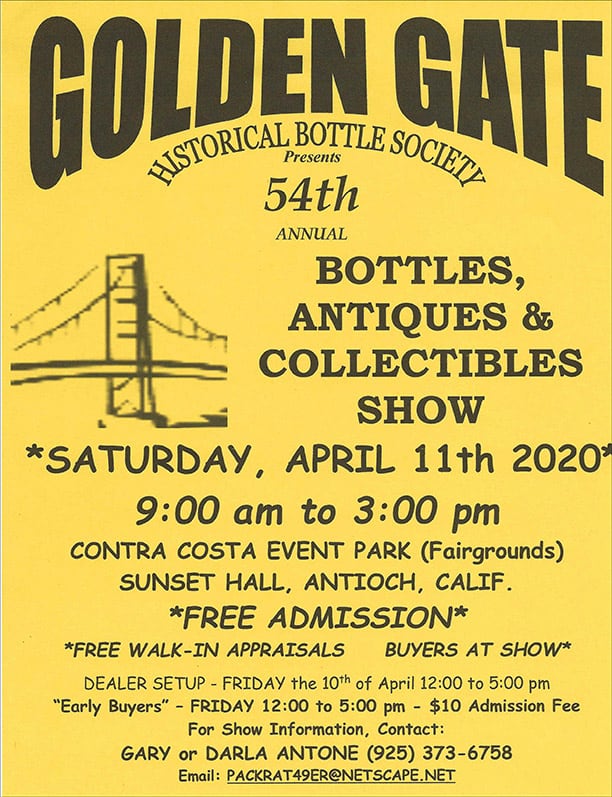
Urgent Notice from Gary Antone, re the Golden Gate Show - Followup

CANCELED


Howdy Bruce,
In conversation with the Contra Costa Event Park ( Antioch ) today, the GGHBS club's show has been canceled until next year. Can you post this information on your website ? The club and I would appreciate it. Not good, but it's understandable. Also FYI, Morro Bay show has been canceled also.


Take Care & Thanks My Friend,


Gary

https://www.fohbc.org/wp-content/uploads/2019/12/GGHBS-2020-show-flyer-yellow-full-page.jpg

 CANCELED


Hello GGHBS Club Members

I hope this note finds you all doing well – keeping safe and sane during this crazy and uncertain time we are in due to the Coronavirus.
Unfortunately, I need to advise that our 2020 GGHBS Show on 4/10 and 11 has been cancelled.   

Decision made based on:
  • The fairgrounds reached out yesterday and advised they are prohibited from having events until at least 4/5 and it could be extended
  • The government issued self-quarantine until at least 4/7, and who knows what will happen between now and then
  • People need to make plans, and not realistic to do if we don’t know what will happen until the day or 2 prior
  • Even if all the restrictions were lifted in time for the event - the club would lose $ that we cannot afford to do. We could not make up for it in time.    
    • Lost table sales, early birds, raffle and food
As hard as it is, its best just to make the decision now, cut our losses, ensure everyone is healthy and just look forward to next year

Next steps:
  • I have initiated contact with the online sites that promote our show and advised of the cancellation.  You will start to see those shortly (along with Morro Bay that was also cancelled)
  • We are working with the fairgrounds to see what happens with our $1000 deposit. 
    • The additional funds for the event were due this week and we had not paid yet, so no worries on that part.

Let me know if any issues or questions.
Take care of yourselves, stay safe, and will look forward to seeing everyone soon.

Gary PFL


Sunday, March 15, 2020


GOLDEN GATE SODA BOTTLE


There is no shortage of bottles that refuse to offer up their lineage in the historical record. One example is the blob top soda water bottle simply embossed GOLDEN GATE. Found on the west coast it surely has its roots in that region, even though it has all the characteristics of being manufactured on the east coast. Beginning some thirty-five years ago, Peck Markota and I would periodically discuss the possible pedigree of this bottle based on research uncovered at that time. Admittedly, very little has changed since then.

The seed for this article was planted when Peck shared with me an article he had found in an old newspaper that described the attributes of the floating palace that regularly plied the route between San Francisco and Panama, bringing gold seekers, their families, and other adventurers to California during the gold rush. The glowing description of the Steamship Golden Gate included a mention of a soda water machine installed on board. Not enough information to conclude that soda water was actually bottled there but certainly something that warranted further investigation. Peck was not convinced, nor was I, and his death left the search to me, which I have been aware of all these years. I had originally possessed a copy of that news article but it has apparently been lost in a sea of paper related to bottles and bottle research that resides in my office. Even with the new onset of digital newspaper research, it has not yet surfaced on-line.

A recent article authored by well known western bottle collector, Max Bell, offered a potential origin of the Golden Gate soda bottle based on his experience and research. (See the March 2020 ‘49er Historical Bottle Assoc. newsletter for his interesting article.) He reported that as many as fifty broken and whole specimens have been excavated in the gold rush town of Yankee Jim’s, in Placer County, California, and may have been associated with a saloon there called the Golden Gate. While there is no documentation of a soda works in the town, this may be a case of a concerted effort to collect and re-use the bottles in association with the saloon.
    
There is no dispute that the name was initially attached to the strait that connects the San Francisco Bay with the Pacific Ocean as early as 1846 by the famous "pathfinder", John C. Fremont, two years before the famed discovery of gold in California. ( see Daily Alta California [San Francisco, Calif.] September 8, 1850, for a description of the term as used in California) Fremont posited that the strait located near the little village of Yerba Buena, soon to become San Francisco, was a "golden gate to trade with the Orient". The term stuck and by 1849, one newspaper reporter noted:
" Company organizations, composed of the flower of each state's population are daily pouring through this golden gate of California, and we have already as large a share of intelligence and capability, truly American, as many of the states of the Atlantic side". (Weekly Alta California [San Francisco, Calif.] November 1, 1849)
 
Later, the term was used to define any number of physical places in the west, from saloons to markets to bridges. It would have been so easy to have established a soda works with that name in any town in California, but  no such documented evidence has surfaced. Certainly, the origin of the bottle could be any of the breweries and saloons that populated central California with that name, but nothing has turned up in all these years that could help in determining the bottle's true owner.

The only shred of evidence is what Peck uncovered related to a rather famous steamer that plied the west coast from San Francisco to Panama and back for nearly a decade. The information was so tenuous that Peck preferred not to publicly speculate on the idea that the S.S. Golden Gate could actually be the origin of the soda bottles that carried the same name. We discussed the issue at length with the hope that a little more evidence would spring forth in the hope that, at the least, even a weak case could be made for the steamer being the origin of the bottles. With Peck's passing I have continued to pursue this avenue but with no conclusive clues being unearthed, except for one more that may provide some circumstantial evidence.

The Steam Ship Golden Gate is one of the most documented vessels to have serviced our west coast. (not to be confused with the clipper ship Golden Gate) Built in 1851 for the Pacific Mail Steamship Company in New York, she was considered the finest ship of her kind when built. She was a double engined side-wheel steamer once described as a "floating palace". The 270 foot wooden hull could accommodate 800 passengers. It was literally a floating city.


The ‘floating palace’ was fitted with any number of amenities to entice gold seekers to book a ticket from Panama to San Francisco. It was upgraded several times in order to maintain its luxury status. If the on-board soda water machinery was part of its initial construction or added later is not known.

Tickets were not cheap. In 1854 a one way ticket from Panama to San Francisco was about $200 for upper deck staterooms and decreased to $45 for a steerage bed. She continued this route until July 27, 1862, when she traveled from San Francisco to Panama and burned at sea where the captain immediately turned her shore-ward and beached in rough surf north of Manzanillo, Mexico. There are many eye-witness accounts on the Internet of the horrors that unfolded on that tragic day. When the burned out hulk met the shallow surf she was broken apart and strewn along the beach, along with the passengers, in all manner of physical condition. Of the 338 passengers and crew aboard, as many as 223 souls lost their lives. (Refer to: http://www.aquaticsportsadventures.com/Articles/Misc/SSGoldenGate/SSGoldenGate.html, for perhaps the best compilation of knowledge on the sinking of the S.S. Golden Gate)


Part of the scenario that caused such a tragic loss of life on the Golden Gate was the wind. Initially many of the crew and passengers ran for the bow of the ship since the wind driven flames were blowing aft. The ship then turned around causing the flames to blow toward the bow, thus stranding many with no option but to jump overboard or be burned to death. Unfortunately many suffered debilitating heat exposure before they jumped, causing them to be in a weakened state before swimming the quarter mile to dry land.

Aside from the great loss of life at the time of her destruction, the ship was most famous for the treasure she carried during that fateful trip.  As well as considerable specie, she was transporting $1.4 million in gold bullion. Today's value of just the bullion would be closer to $51.5 million. Over the next few years considerable effort was expended in recovering the gold with most of it found, however, no one is sure how much may still lay on or under the sea floor.

The survivors were stranded on a beach with no food, water or shelter. One account notes that, "A group of men was sent to scour the debris scattered along the beach and to retrieve any items that they thought would be useful. Among the most valuable finds were crates of unopened soda bottles that were packed in sawdust and must have floated up from the hold." (Legend of the Golden Gate. Roman Rivera Torres. 2003, pg. 140) A natural question would be; why would the Golden Gate be carrying soda water in bottles from San Francisco toward Panama? Since there were no glass works in California at that date soda bottles would need to be shipped to California, not from it. And full bottles make even less sense. Unless, of course, they were to be used by the passengers, which would be especially in high demand on the return trip from Panama.

It has been a subject of confusion that there has been no locus for where the Golden Gate soda bottles have been found. While numerous western population centers are the most common locations they are also found in less densely populated areas as well. Could it be that the bottles were taken from the steamer by travelers as a memento of the trip to California and eventually discarded throughout the West, wherever the new immigrants may have settled? This seems very plausible and could explain a lack of concentration around a land-based use point. The Golden Gate bottles have been found as far north as Portland, Oregon, and to the south in San Diego, California.

With an idea that the Golden Gate bottles may still be associated with the wreck of the steamer, I contacted Terry Scovil who is a recreational diver and part owner of Aquatic Sports and Adventures in Manzanillo, Mexico. (Terry Scovil, Aquatic Sports and Adventures, Santiago, Manzanillo, Colima, Mexico.) He is familiar with the wreck as well as many of the diving community in that part of Mexico. Terry made contact through his communication network and social media to determine if the Golden Gate bottles have been found in the vicinity of the wreck site. It was, of course, a long shot, but worth a try. No one responded positively to his query.

Of course, this conjecture could easily spill over to yet another soda water type bottle, simply embossed EL DORADO, yet another bottle carrying the same name as a ship, and with no known land based proprietor.


Two distinct molds were used for the manufacture of the Golden Gate soda water bottles.  Of greatest interest are the bottles from the earliest mold, which appear to have all been blown with the use of a bare iron punty rod. What are likely the earliest specimens appear to be produced with a clean and readable embossing.


 Later specimens begin to show a more degraded embossing as the mold began to ‘wear out’.  Could this be because the mold was stored aboard the ship and exposed to the salt-water environment that would be expected in the hold? We simply don’t know but it is possible.


What is assumed to be the later mold has slightly different embossing and all the bottles examined have well formed words with no degradation. These specimens all have a basal hyphen between the two words.  Since the Golden Gate sank in 1862 the later mold may not have been used long enough to show any signs of pitting. This variant has no pontil.


Further comments on this subject are always invited.


The loss of the S.S. Golden Gate had such an impact on the people of California that a song was even prepared about the tragedy

Monday, March 9, 2020

Wednesday, February 26, 2020

"Hamburger Tropfen Bitters" Mystery no more


The Hamburger Tropfen Bitters and John Carl Mitau. We know that Wm. Hoelscher & Co. from San Francisco, was the agent for the brand. The embossing on the bottle reads "Hamburger Lebens Tropfen", which in german means "Hamburg Life Drops"  But, where was it from and who was John Carl Mitau? Well, I just discovered this article in the "Independent Calistogian" March 19, 1884, newspaper from Calistoga, California.
 
 
There you have it. A Calistoga, California Bitters and John Carl Mitau is from Germany. He manufactured the popular "Hamburger Tropfen Bitters" and brought it to California. Also, Could it be possible that Wm. Hoelscher was the relative they refer to, that assisted J.C. Mitau in bottling, marketing and selling his stomach bitters here in California. I believe so.
 
 
This western bitters lasted from 1884 - 1906. Wm. Hoelscher & Co. trade marked the brand in 1900. The first bottles were label only followed by the embossed bottle by the late 1890's. Making the embossed bottle extremely rare with only a hand full known, in either aqua or amethyst seen here. 


Saturday, February 15, 2020

Miracle Dig and Beginners Luck


Getting permission to dig is no easy task these days. So is the case with this project. It took a lot of hard work and 3 1/2 weeks to finally get permission on a major project. Now that is not the miracle here. The miracle is that the bottles you see have been saved or rescued from not only the ground but from an excavator, a dump truck and a D6 Cat on a construction site. The mere fact that they exists is the miracle.
     Now, the story gets better. Yeah I may have found some good sodas. But, one of the young guys that was running a bobcat with a sifting bucket for getting the junk out of the dirt, along with bottles in the process, didn't know anything about bottles. But, he and his dad do collect Native American items and metal detect for gold. So he has the collecting bug already. At the beginning he started pointing out bottles for me and picking them up himself. Then he wanted to know more about bottles and had some great enthusiasm. His excitement for the hobby was fun to see and he is a young guy. So, I started teaching him the ropes and wanted him to keep what he found. I told him the history of every bottle he found. He got more into it. He even told me his dad really liked the bottles and history also. They went as far as to build a shelf to display his new bottles. Everything from blue bromo's to the whiskey you see here. Yes, he rescued this piece of history from destruction. I was next to him while he was operating the Bobcat with the sifting bucket. He runs the Bobcat into the pile of dirt super fast and picks up a load and shakes it. This time he stopped and kept the bucket up, crawled underneath and grabbed it. He turned to me and asked, Mike what is this. I about shit my pants. I could not believe what I saw. A beautiful Jockey Club Whiskey. The look on his face when I told him what he had found was priceless. The fact that this bottle exist is a true miracle. I told him to keep it for as long as he can, don't part with it. He was over the moon with excitement and I was excited for him. The best part for me is that the young guy Seth who found the whiskey along with his dad are now new bottle collectors and are looking to learn more. He is also looking forward to going to his first local bottle show. Now, isn't that what the hobby is about. The most fun I had digging in a long time. Many thanks guys.