
Sunday, December 14, 2014
The Colors of the Season
I wanted to wish everyone a Merry Christmas with the colors of the season...red and green. 2014 has been an epic year in glass and here is hoping everyone has a fantastic 2015! Dale and Melissa.

Friday, December 12, 2014
2014 49er Historic Bottle Show a Success!
The Roseville Show was a great success - Jerry Forbes
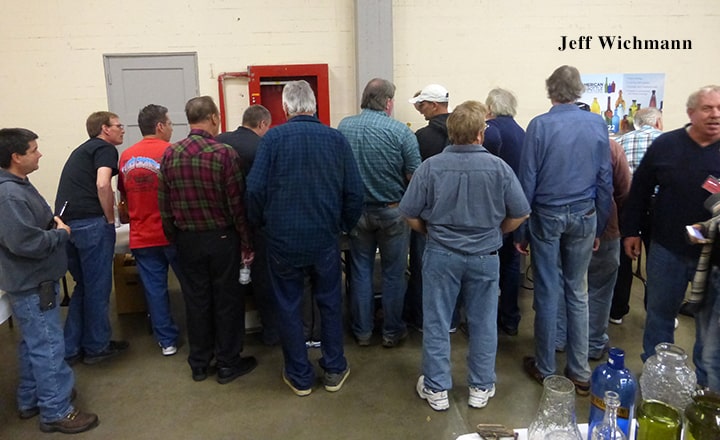
,
Good show that was well attended. I was surprised by the number of people compared with last year. I saw a good number of sales so there should be a lot of happy sellers. I am having some photo issues on my computer so will pull a few directly off my camera.
The first is the table of Jeff Wichmann. You would think he was giving away bottles as it was jammed with potential buyers for a good while. I don’t even know what was so great because I couldn’t breach the crowd. That is Jeff, himself, on the right side, who could not even get to his own table!
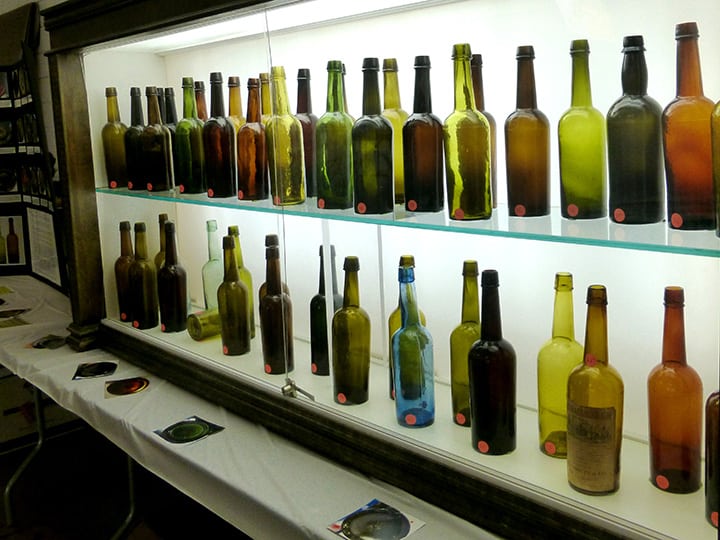
The second photo is a major display of unembossed whiskey bottles except for the base markings which included a central ray generally described as a “star”. Max Bell put this together but It had a number of contributors and is a sort of esoteric collecting specialty in the West as a good number – maybe all – of these bottles have been attributed to the San Francisco glass houses.
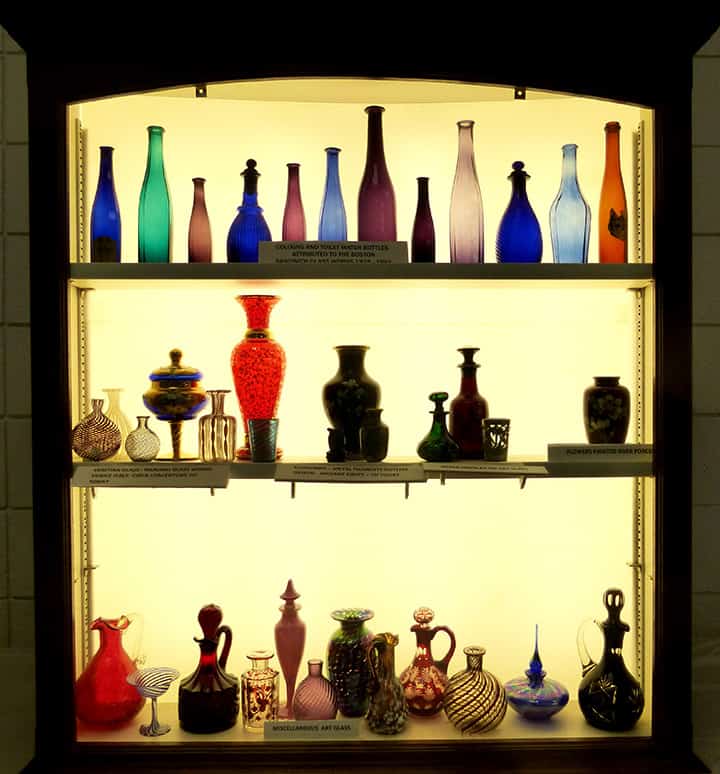
The third photo is a nicely lighted display of colognes included some “swirled” glass.
.
Eric M. (McGuire)
This year’s show had some very interesting and exciting bottles appear on tables for sale, including an American Life Bitters (Omaha, Neb.), St.,Nicholas Stomach Bitters (small size), Dr. Henley’ s Eye Opener, Cassin’s Grape Brandy Bitters, Alex Von Humboldt’ s Stomach Bitters, New Almaden Vichy Water (large size), E.G Booze Cabin Whiskey, Kelly’s Old Cabin Bitters, Holtzerman’ s Stomach Bitters (two roof), Bryant’ s Stomach Bitters (both cone & leg variants). A lot of bottles exchanged owners during this show! A very memorable show for me.
Warren Friedrich

Congratulations to show chair Mike McKillop, club president Max Bell and the 49er club.
Thanks to Eric McGuire, Warren Friedrich, Jerry Forbes and Peachridge Glass for the pictures and review of the show - rs -
Wednesday, December 10, 2014
More on the Hamburger Trophen Bitters
From researcher extraordinaire Bruce Silva:


Spotted Dales post on the Hamburger Trophen Bitters along with his notation that Wm. Hoelscher was the distributor. I first got to looking through the books by Wilson, Thomas & Wichman, and noted what they had regurgitated over the years about Wm. Hoelscher. Next, I accessed directories and newspapers from the era in hopes of adding something concrete that Dale could add to the article, and which would support the idea that the bottle he has was indeed distributed by Hoelscher.
That little exercise turned into an eye opener as just about everything written is wrong. Wm. Hoelscher died in the fall of 1880... Here's the string of events that I uncovered;

I never could document if the embossed case style bottle was, or was not, distributed by the company. There was nothing in the way of sole agency, or other advertising in any of the California or Nevada papers for the brand, and the firm didn't puff it in any of the liquor trade publications. The paper label that Wilson and Wichman pictured appears to date TOC, but the firm never advertised the brand, so until a bill head surfaces, dating will remain a mystery.
Always impressed with Bruce's investigation of a subject no one else seems to want to research. The Hamburger Trophen Bitters also comes in a small "sample size" embossed bottle. I have dug several examples in Sierra City over the years. Thanks Bruce for taking the time to run down the info on Hoelscher. - rs -
The first go round on this post the newspaper clips were missing - I corrected this - rs -
The first go round on this post the newspaper clips were missing - I corrected this - rs -
Sunday, December 7, 2014
San Francisco Milks
Just in from Ken Morrill


Thanks Ken for some very interesting info on a rarely seen or discussed field of western glass collecting
Hamburger Trophen Bitters
Here is an aqua case gin style bitters which has been a mystery to me for years. This aqua tooled top is very elaborate in it's embossing with what look like Veloceraptors on both sides of a crest. These are pretty rare and this is the only example I have actually handled. It showed up in Roseville this week.
According to several western bitters references, this was a bitters put up by Wm. Hoelscher & Co. in San Francisco. Hoelscher was also responsible for a few nice western whiskey bottles. I believe the Hamburger Trophen Bitters was distributed in the 1890s and other than not being milk glass, closely resemble the Rothenberg, and Hartwig case gin bitters from the same time period. I have no clue who John Carl Mitau was, but hopefully someone does. I would also like to know how many of these exist in collections. I know they also come in an amethyst in addition to this aqua.
Kind of an odd ball but a nice and rare western bitters from a well known Western liquor distributor.
DM
( As always, click on the photo to enlarge)

According to several western bitters references, this was a bitters put up by Wm. Hoelscher & Co. in San Francisco. Hoelscher was also responsible for a few nice western whiskey bottles. I believe the Hamburger Trophen Bitters was distributed in the 1890s and other than not being milk glass, closely resemble the Rothenberg, and Hartwig case gin bitters from the same time period. I have no clue who John Carl Mitau was, but hopefully someone does. I would also like to know how many of these exist in collections. I know they also come in an amethyst in addition to this aqua.
Kind of an odd ball but a nice and rare western bitters from a well known Western liquor distributor.
DM
( As always, click on the photo to enlarge)
Wednesday, December 3, 2014
ROSEVILLE ! December 5th & 6th 2014....See You There!
 |
This years display will feature western star base whiskies
PACIFIC GLASS WORKS BASE EMBOSSED BOTTLES
COME TO ROSEVILLE AND SEE THE STARS SHINE!
 |
Tuesday, December 2, 2014

A Recent Attic Find!

Here's a recent attic find. Nice turn of the century Damiana Bitters from the company famous for Phoenix Whiskey, Nabor, Alfs and Brune.
Check out the label and intact neck foil!
Monday, December 1, 2014
The Old Church Dig
Here are a few photos of a recent dig
behind an old church sent in by a anonymous digger:

"Church holes are pretty good in my
experience. This 1870s church had two holes behind it with one consisting of
local druggists, foods, and liquor bottles. The second one was 1890s and had
numerous inks, one liquor and this beautiful crucifix candle stick. It was next
to the small demijohn in the hole".

While not an early 60s pit, it was
fun and the candlestick was great to find behind the church.

.
Sunday, November 30, 2014
Speaking of Star Base Blacks
The Sierra Buttes Mine
It is said that the mine was discovered by a company of Italian miners, that were prospecting the area, and was first worked with arrastra’s in 1851. A company of English investors took control of the mine in the mid 1850's. It is possible that the original discovery site was near Independence Ravine where a huge quartz outcropping can still be seen today. The mine was worked on nine main levels and the levels were designated as tunnels one through nine; tunnel number one being the highest in elevation and the oldest of the workings, and nine being the lowest and newest.
A small camp started around the mine as early as 1851 and after the heavy snow during the winter of 1852 - 53, that crushed most of the buildings in Sierra City, a settlement started to emerge at the mine site. All manner of business was represented at the site except for the sale of liquor. Company policy stated liquor was prohibited on the mining property. It is interesting to note that, although liquor was prohibited at the Sierra Buttes Mine, scores of liquor bottles ranging in age from the early 1850’s to the late 1880’s have been discovered at this site. The Sierra Buttes Mine was the perfect example of a early "company town". Most, if not all, of the workers lived on the mining property in boarding houses with the mine bosses residing in small cabins located away from the boarding houses but still on mine property. Company owned stores supplied everything from candy, tobacco, fancy foods to jack knifes and clothes to the miners that worked the property.
The number one tunnel, and the boarding house for those workings, have yielded gold rush bottles and artifacts but it the authors contention the area around the number six tunnel was the site of the settlement started after the heavy winter of 1852 -53. Weighing in favor of this contention is the fact that the area around the number six tunnel has a natural gently sloping flat that was suitable for the construction of buildings and was not as steep as the area around the number one tunnel. The amount of abandoned structure sites discovered in the number six area far outnumber the couple of sites around the number one tunnel and boarding house. Bottles and artifacts ranging from the early 1850’s to the middle 1880’s have been recovered from the number six area dating the site as a settlement in continual use since the early 1850’s. Everything from pontiled umbrella inks, early star base English blacks, open pontil medicines to western whiskey fifths and bitters along with several S.F. Gaslight Ammonia's have been recovered from the number six settlement area.
Today the Sierra Buttes site is still private property but heavy brush covers the site and all that's left of this important gold rush settlement are acres of broken glass and scattered trash.
Located north of the small town of Sierra City - The Sierra Buttes Mine was one of the largest and longest producing mines in Sierra County. Discovered in the late summer or early fall of 1850 this mine employed a major population of the town of Sierra City and was worked for over eighty years.
 |
| Early view of the Sierra Buttes Mine |
 |
| Arrastra in Buttes Ravine ( note gin pole in upper right of photo) |
 |
| A group of miners at the Number Six Tunnel Portal (note the candles instead of carbide lamps) |
Wednesday, November 26, 2014
Huh? Star Base Black...

Dale's post about his 8-Ray Star Base Patent Fifth reminded me of this black glass ale I've had in my garage for a few years. It has a few embossed letters (almost resembling that of directional abreviations N,E,S,W). I'll get some additional pictures posted in the next few days showing the bottle itself, as well as a better close-up of the letters, which I remember being a "C, M, W" or "G, M, W"
Any thoughts or information would be of help in identifying the manufacturer of this star-base bottle.
Tuesday, November 25, 2014
Huh? Star Base Fifth...
While going through some boxes this week, I came across a crude and early "Patent" fifth. Nice deep olive amber and swirls throughout. Pretty neat piece of early glass I thought. I had not previously noted the base characteristics or perhaps forgot, but there it is...a "star". Hmmm...what is this? Embossing? Yes, it is embossed "Dixon & Co. Liverpool" around the base. So, I guess San Francisco was not the only glass works to emboss a "star"...I know that some U.S.A. Hosp. Dept. bottles and even some Hostetter's have some version of the "star" but I had not seen an English bottle with this type of "star". DM


Sunday, November 23, 2014
John S. Bowman - Old Jewel Bourbon
 |
| John S. Bowman Jewel Bourbon sign. |
John S. bowman was a wholesale liquor and wine dealer in San Francisco from 1886 to 1892. He also dealt in the bitters market for a brief period (Jewel bitters ) His wholesale liquor outlet was at 213 Battery Street.
In the brief period that he was in business he produced at least five embossed bottles to advertise his products.
The first known Jewel Old Bourbon fifth was dug near Silver Peak Nevada in 1969. A few years later one surfaced in Quincy California. Since these first discoveries other examples have been found in Nevada and northern California. As of 2002 there are seven ? known examples.
The Jewel Old Bourbon flasks are amber and have a tool top and they only occur in the pint size. At least three of these flasks have been found along the Salmon River in northern California. One other Jewel flask is known to have come from the old ghost tow of Bellville Nevada. As of 2002 four of the Bowman Old Jewel flasks are known.
Thanks to the late John Thomas for the information on Bowman's Old Jewel Bourbon
( I couldn't find any pictures of the Jewel Bourbon - anyone have one to share)


Thanks to Bruce Silva for the Bowman ad and fifth picture - rs -

Wednesday, November 19, 2014
Dr. Henley's Regulator
The Dr. Henley's Regulator is one of the most rare and sought after of all the Henley's products. This "Liver Regulator" was produced from 1867-1876 yet there are few ads featuring this medicine. These are impressive pieces of glass at 8 1/2" tall and square in form. I can account for seven examples of the Regulator in collections and most were found in and around Portland, Oregon. I know of one example dug in Sacramento. Wilson listed it as "very rare" but I would consider it extremely rare. Each Regulator I have handled was different in characteristics from green aqua, regular aqua to a deep blue aqua in color, and from quite plain, to hammer whittled. I consider this to be one of the most desired western medicines with a lot going for them...Age, size, applied top, the Henley name, stylized "R"s, nice color and character, and of course scarcity. For a bottle supposedly made for nine years, I wonder where they all are? Portland had no organized recycling program, and therefore "dipped" holes are rare. It is amazing that these are not more common given the thousands of holes dug there over the decades. I have not heard of a Regulator being dug in Nevada ( the land of the good stuff), which is funny as I know of one "heavy" Oregon Unkweed Cure dug there. About every Henley product has been found in Nevada but no Regulator? The entire Dr.Henley product line is a real challenge to collect and as soon as the "Dew of the Alps" start coming out, I will have them all....except the Tamarack...and the Excellent....well, I will likely never have them all, but I surely hope someone will! DM


Friday, November 14, 2014
Early SF Pot
Here is an early looking pot dug in San Francisco. I have only dug the City a few times so this may be a relatively common pharmacy piece.
 .
.
I have not seen one before. Any thoughts on it's age and scarcity?
Thanks! DM
From Bruce Silva:

From western researcher Eric McGuire:


I have not seen one before. Any thoughts on it's age and scarcity?
Thanks! DM
From Bruce Silva:
This piece has some damage to the reverse, but it's
a rare piece. I found reference to him as far back as 1854 directory, and in
the 1857 S. F. directory at this address. I believe this to be an
early and historically significant S. F. piece
I dug in the City for years and only found one Chevallier pot, and I have seen another. The two attached items pretty much sum up his life in a really shortened form.
Interesting advertisements from Eric - maybe we should be looking in Southern California for the Chevallier artifacts - rs -
Thursday, November 13, 2014
Hello Rick, hope all is well with you and Cherry ? I thought you might enjoy seeing some of

our blue and pink demijohns. I was really happy with the way the light reflected off of them, made me think they were on fire If you can use them on the site, please feel free to, counting the days now to the Roseville show !
All the best, Dale and Barbara


our blue and pink demijohns. I was really happy with the way the light reflected off of them, made me think they were on fire
If you can use them on the site, please feel free to, counting the days now to the Roseville show ! All the best, Dale and Barbara

I am partial to those electric blue demi's - but my two granddaughters just love pink! - rs -
Tuesday, November 11, 2014

Thursday, November 6, 2014
Just in from Dale and Barbara Santos
" I wanted to share some photos of a very rare shaped New England demijohn that was dug in Sacramento, CA by John Fountain in 1967. It was dug in the area that houses the Train Museum in Old Sacramento. It still had some wicker on it and was found near a foundation. This form is extremely rare and

I have never seen another in this shape. I thought the East West connection was quite fascinating. One can only speculate as to how it made it to California. This form would date to the 1840s period. Thought you might be able to use it on the site, all the best, Dale and Barbara. PS the gentleman that I acquired this from was with John when he dug it, it was given to him by John."

I have never seen another in this shape. I thought the East West connection was quite fascinating. One can only speculate as to how it made it to California. This form would date to the 1840s period. Thought you might be able to use it on the site, all the best, Dale and Barbara. PS the gentleman that I acquired this from was with John when he dug it, it was given to him by John."
Thanks Dale and Barbara for the great story and pictures of this unusual demijohn. It always amazes me how these things survive. I dug a green one gallon demi eight feet below street level here in Downieville that was sitting straight up when it was uncovered during the installation of a septic system - rs -
Wednesday, November 5, 2014

Monday, November 3, 2014
Sierra County Gold Rush Camps
The North Fork Bars
From
Goodyears Bar to Indian Valley

Texas Bar
Located
on the north side of the North Yuba about a 1/8th of a mile west of Goodyears
Creek this settlement was quite possibly founded by miners from Texas in the
early 1850’s. Later mined by Chinese miners the bar was worked with water
wheels and derricks. It is believed the Chinese settlement also had a Joss, or
Chinese temple, erected at this site. Remains of a stone structure, with
scattered Chinese pottery around it, lead me to believe that indeed, a Joss
house existed at this site. The re-alignment of Highway 49 during the 1960’s
partially covered this gold rush era camp. At the present time this area is a working mining claim owned by a Sierra City resident
This
small mining camp was located one quarter mile below Goodyears Bar on the south
side of the Yuba River is said to have received its name from the way the local
Indians said “How do you do” sounding like Hoodoo. Although this bar was mined
in the early 1850’s there is no mention of activity at this site until 1863
when a store and several houses are listed by the Sierra County Tax Collector.
A foot trail from Goodyears Bar, on the south side of the Yuba River, leads to
a bluff above Hoodoo Bar. On this bluff remnants of the store, cabins and gold
rush era bottle shards are scattered about the area. Several un embossed open pontil bottles were recovered from this site
As
early as 1850 this good size bar located one quarter mile below Hoodoo Bar was
prospected and mined for gold. Major Downie filed a mining claim and built a
cabin at this site in 1851. Mined from the 1850’s until the early 1880’s a
store, warehouse, bridge and several cabins were constructed at Rantedottler
Bar and gold production was steady but not spectacular. Several floods and high
water have disturbed this site and little remains of this gold rush camp. In the winter of 1991 the Yuba River froze and a couple of us walked across to this gold rush site. Heavy deposits of river sand have totally covered the area that contained the main portion of the camp
Located
a short distance above St. Joe Bar this small gold rush camp received its name
supposedly from a sick German miner who cut his throat at this site. This camp
should not be confused with the supply and mining camp further down the Yuba
River near Canyon Creek and known as Cut-Eye Foster’s Bar. Of the little amount
of information available on this site it is known that Ah Sing and Ah Chime
sold to Ah Tsung a mining claim at Woodville Bar in 1865 and Ah Youw was
operating a derrick and two water wheels during the same period. From this
information it can be assumed that during the early 1850’s gold rush miners
worked this area and later on it was re-mined by Chinese miners.
Another
settlement to develop in the vicinity of Goodyears Bar was a camp with the
early name of St. Joe Bar. Founded sometime in 1850 and boasting a store as
early as 1852. it was a significant enough settlement to hold a meeting in 1852
of several hundred miners to determine the mining laws of the district. In the
mid 1850’s the bar was renamed Ramshorn and re-mined by Chinese miners. Chinese
pottery, gold rush bottles and artifacts have been found in the area
documenting the early settlement of this site. The United States Forest
Service’s Indian Rock Picnic Ground now occupies St. Joe Bar.
St. Catherine Creek
A small gold rush camp of maybe four or five structures was located where St. Catherine Creek empties into the Yuba River. At this site small level platforms were constructed from boulders and fill dirt to hold the tent houses or crude cabins that occupied this site during gold rush times. At this site 1 intact cathedral pickle and several small un embossed open pontil bottles were recovered along with the wreath section of a gold rush belt buckle. This area is now a mining claim and is worked every summer by the claim holder.

Saturday, November 1, 2014
The Many Shades of Aqua
From the Utah Antique Bottle Cliché

Where does it begin and where does it end? We all have our own interpretations. My first encounter with aqua variations was years ago, my first bottle purchase through one of the old bottle magazines. No pictures back in those days, just description and price. Green soda bottle in good condition. When I opened the box and saw the pale aqua soda I was a little bewildered. Later referring to some bottles as eastern green. Add that to the western fire aqua and the list goes on. Don't forget to factor in the color blind
Subscribe to:
Posts (Atom)


